 CONTACT
 gallery
 facebook
 instagram
 youtube
 twitter
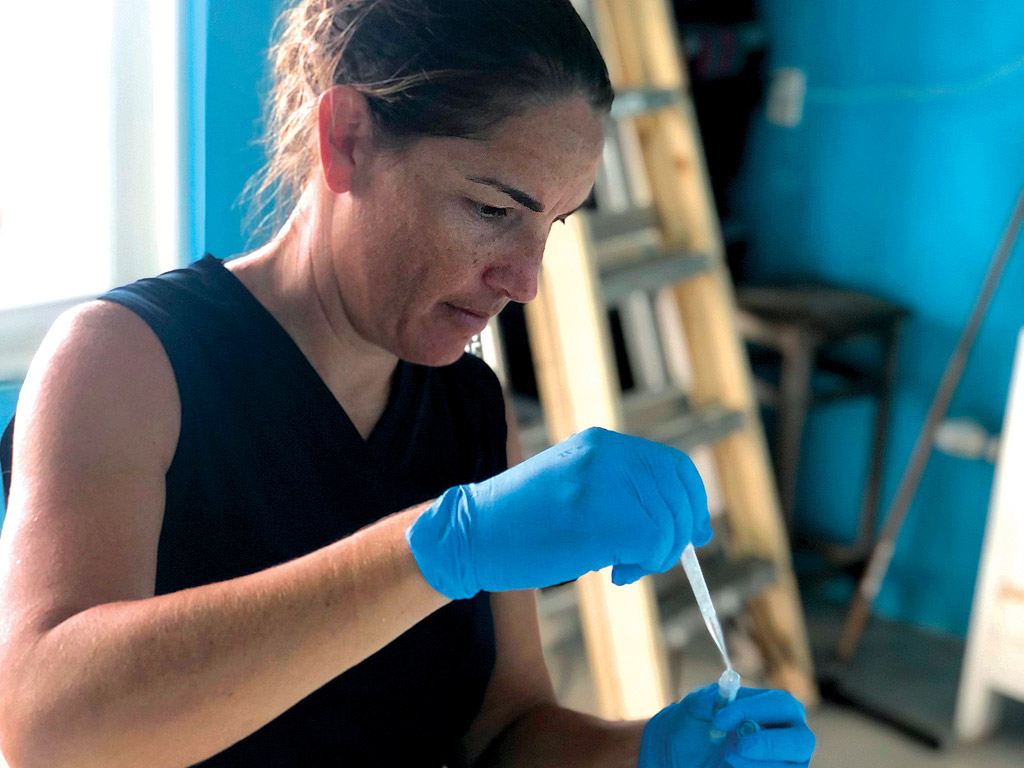
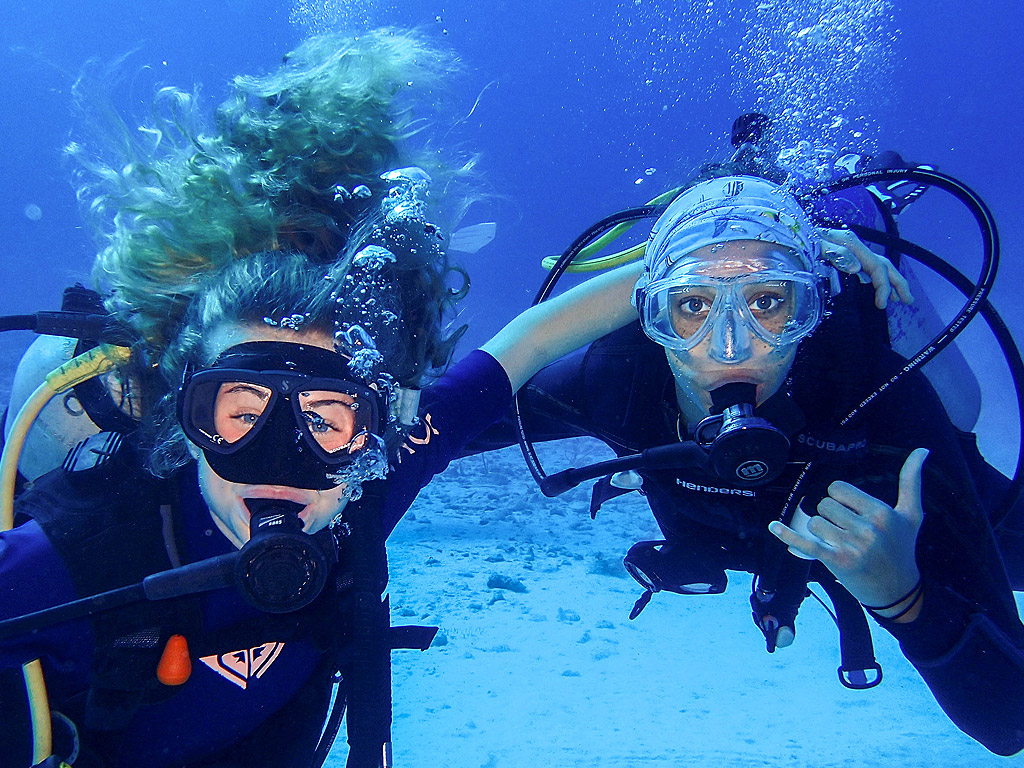
Amy Morrison is originally from central Scotland and has long been drawn to the ocean. She holds a BSc in Marine Biology from the University of Aberdeen and an MSc in Tropical Marine Biology from the University of Essex.
She gained experience in marine conservation across the Caribbean, developing a strong passion for the region and its coral reef ecosystems. During her master’s studies, she conducted her thesis research on Utila, Honduras, where she led a team of university students in reef monitoring using advanced techniques such as stereovideo surveys and 3D habitat modelling. Between degrees, she completed a marine conservation internship in Mexico, where she also achieved her Divemaster certification.
Most recently, she worked as a marine biologist and Divemaster for a marine conservation non-profit in the British Virgin Islands. In this role, she coordinated coral-focused projects and contributed across a wide range of research and conservation activities, including reef monitoring, artificial wreck surveys, cetacean research, shark tagging, ghost gear cleanups, and community outreach.
Haley joins CCMI from the National Oceanic and Atmospheric Administration’s Office of Habitat Conservation, where she worked as a Marine Habitat Resource Specialist and Presidential Management Fellow (PMF). In this role, she provided technical and policy expertise to support large-scale, community-based restoration programs in the Gulf of Mexico, advancing sustainable marine resource management.
Haley’s background integrates theoretical ecology, functional adaptation, and ecosystem connectivity to better understand how marine communities respond to warming and other stressors that shape ecological resilience and recovery. She earned her B.S. in Natural Resources and Environmental Sciences from the University of Illinois at Urbana–Champaign and an M.S. in Biology from the University of North Carolina at Chapel Hill, where her graduate research examined how nutrients and temperature influence macroalgal and coral communities in the Galápagos.
As a WIOSA Scholar, Haley is leading studies to identify key drivers of seagrass meadow health and blue carbon potential in the Cayman Islands—both critical components of coastal resilience. Her research will establish an ecological baseline linking habitat setting to seagrass condition and productivity, and help explain patterns in carbon storage capacity, resilience to disturbance, and ecosystem recovery.
Haley is excited to contribute to work that advances nature-based solutions, fosters local collaborations, and informs future conservation and restoration efforts in the region.
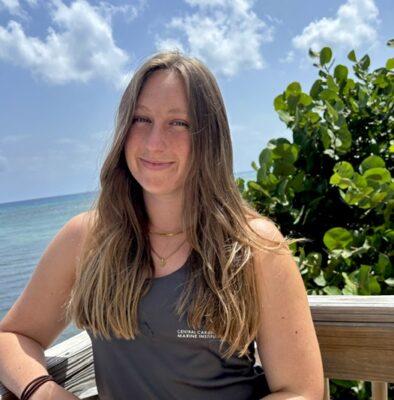
Elana was born and raised in Grand Cayman and started diving at 12, developing a love for her home’s beautiful and unique marine ecosystems. She has a BSc in Biological Sciences (Genetics) and recently graduated from Imperial College London with an MSc in Ecology and Conservation. For her thesis, she travelled to Abisko National Park, Sweden, to research the impact of environmental change on Arctic ecology. She has since worked remotely as a research assistant on a project investigating the relationship between global biodiversity loss and ecosystem services.
After interning with the Cayman Islands Department of Environment where she helped with coral disease mitigation, she realised her true passions lay with tropical marine conservation. Like many Caymanian kids, she visited CCMI in primary school and is excited to have returned and to help conserve the reefs she was raise with for future generations.
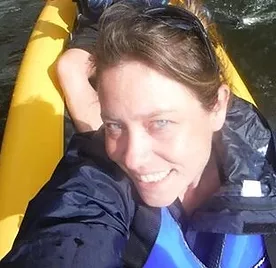
Dr. Zoe Pratte received her BS in Marine Biology from Eckerd College, and her PhD dissertation at FIU focused on the microbial ecology of Caribbean corals. Since receiving her PhD, she has also studied the microbes associated with hundreds of species of tropical fishes, corals, and elasmobranchs. She specializes in the ecology of the microbes that live in and on these marine animals and how they affect animal health.
At the Central Caribbean Marine Institute, she will be investigating the relationship between the common coral symbiont Endozoicomonas and coral health, species, and depth.
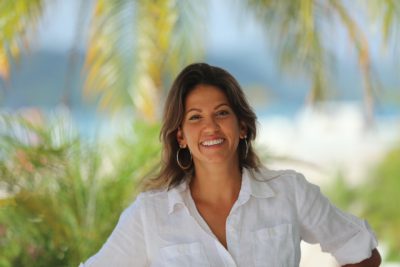
Dr. Laura Marangoni is a postdoctoral fellow at Smithsonian Tropical Research Institute with the Rohr Reef Resilience Program, contributing to a large-scale programme investigating the potential drivers and mechanisms of Tropical Eastern Pacific coral reef resilience. Laura completed her BSc in Marine Biology at Santa Cecília University, Brazil, and her PhD in Biological Oceanography at the Federal University of Rio Grande, Brazil. She then held a postdoctoral position at the Scientific Centre of Monaco as part of the Coral Ecophysiology Team.
Dr. Marangoni´s research focuses on the physiological and biochemical aspects related to the process of coral bleaching. Her current projects include collaboration with Dr. Christine Ferrier-Page, from the Scientific Centre of Monaco, and Prof. Oren Levy from Bar-Ilan University, Israel, developing improved strategies to be applied in reef restoration programs. Also, since 2018, she has worked in collaboration with Prof. Levy investigating the effects of light pollution on corals’ physiology. Laura also collaborates with the most important Brazilian NGO dedicated to the conservation of Brazilian reefs, the Coral Vivo Project.
At CCMI, Laura’s research will look at the physiology of corals in the CCMI nursery and how changes to the corals’ diet might increase their success after outplanting.

Eva is from Middlebury, Vermont, and she graduated from Cornell University with a degree in Biological Sciences, concentrating in Marine Biology. During her studies, she spent time at Shoals Marine Laboratory and the University of Queensland in Australia, and over the past year she has gained hands-on experience in coral restoration and reef grazer research in the Florida Keys.
At CCMI, Eva will be working on the Blue Carbon Offset & Biodiversity Programme, supporting research into how healthy marine ecosystems can help fight climate change. She is especially excited to keep developing as a marine biologist while experiencing life on Little Cayman.
Fun fact: Eva has logged more than 145 dives and is always eager to jump back underwater!
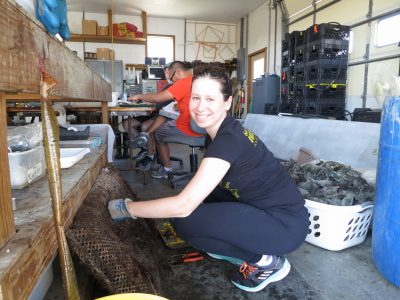
Dr. Sarah Gignoux-Wolfsohn was selected as CCMI’s first WIOSA Scholar in 2020. Dr. Gignoux-Wolfsohn, who is studying the effects of bivalve community diversity on the distribution of pathogens and related microbial communities at the Smithsonian Environmental Research Centre, will be studying the bacterial origins of Stony Coral Tissue Loss Disease (SCTLD) in Cayman this coming July for her WIOSA project.
She earned her BA in Biology and French from Wesleyan University and a PhD in Ecology Evolution and Marine Biology from Northeastern University. Her current research focuses on:
- the ability of populations and communities of micro- and macroorganisms to recover from disturbance by novel stressors,
- the potential for biodiversity at all levels to buffer stressors, and
- the importance of including pathogens in biodiversity monitoring and assessment to improve conservation
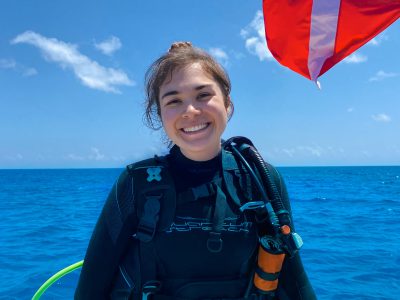
Cali is a senior at Harvard College who is studying integrative biology. She has known since her sophomore year, after taking a tropical biology course, that her future work clothes would be a wetsuit and bucket hat—not a blazer and stockings. Her interest in the field has taken her across the globe, from the Great Barrier Reef in Australia to the Bermuda Institute of Ocean Science in Bermuda – and now to Little Cayman – where she continues to utilise her field and laboratory skills to investigate thermal tolerance in corals. Cali is specifically interested in the thermal tolerance of corals and hopes to continue building her skills and confidence in coral biology research before applying to graduate school.
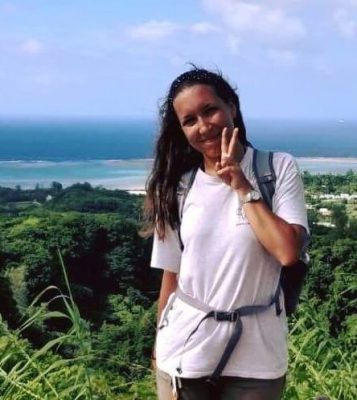
Selected as a WIOSA Intern in spring 2020, Federica’s interests are in the field of marine ecology, with a strong interest in species associations and ecological interactions in marine benthic communities, spanning from tropical to temperate seas. She earned her Bachelors in Biology from University of Milan-Bicocca in Milan, Italy, and her Masters in Marine Biology from the Università Politecnica delle Marche in Ancona, Italy.
Federica is currently pursuing a PhD at the University of Helsinki, where her doctoral project will use ecological network analysis to investigate ecological interactions between macroalgae and seagrasses and their associated fauna in the frame of environmental and climate change.
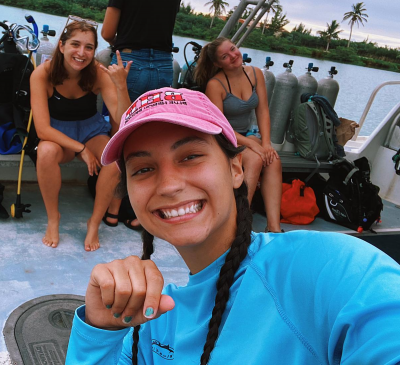
Siarah Hall is a senior at Louisiana State University, where she is pursuing her undergraduate degree with a major in Coastal Environmental Science and a minor in Marine Biology. In the fall of 2021, Siarah completed a research project titled “Exploring variability in light-use efficiency of coral reefs” during an internship at Bermuda Institute of Ocean Sciences.
Passionate about conservation, sustainability, and climate change action, Siarah ultimately hopes to make a positive difference in the health of our world’s ecosystems – especially the marine environment. In her free time, she enjoys tending to her many plants, gardening, staying active, and cooking healthy meals.