DATES:
FRIDAY 20 MARCH
FRIDAY, 10 APRIL
FRIDAY, 8 MAY
FRIDAY, 5 JUNE: WORLD OCEAN DAY
Broadcasts begin at 10 am local time in the Cayman Islands (UTC -5) and last approx 40 min. Topics will be announced in early 2026.
As terrestrial beings, most people are challenged to understand the unique processes of the ocean or even fathom being able to take the plunge and dive below the waves. Among the challenges is that urban, rural and geographically land-locked people perceive the ocean to be a distant place beyond their reach. In addition, scientists are often conducting research on relevant topics at remote locations where it is virtually impossible for the majority of the general public to gain a first-hand experience. This reality creates enormous financial, logistical, physical constraints on bringing people into the field where they can directly explore the ocean.
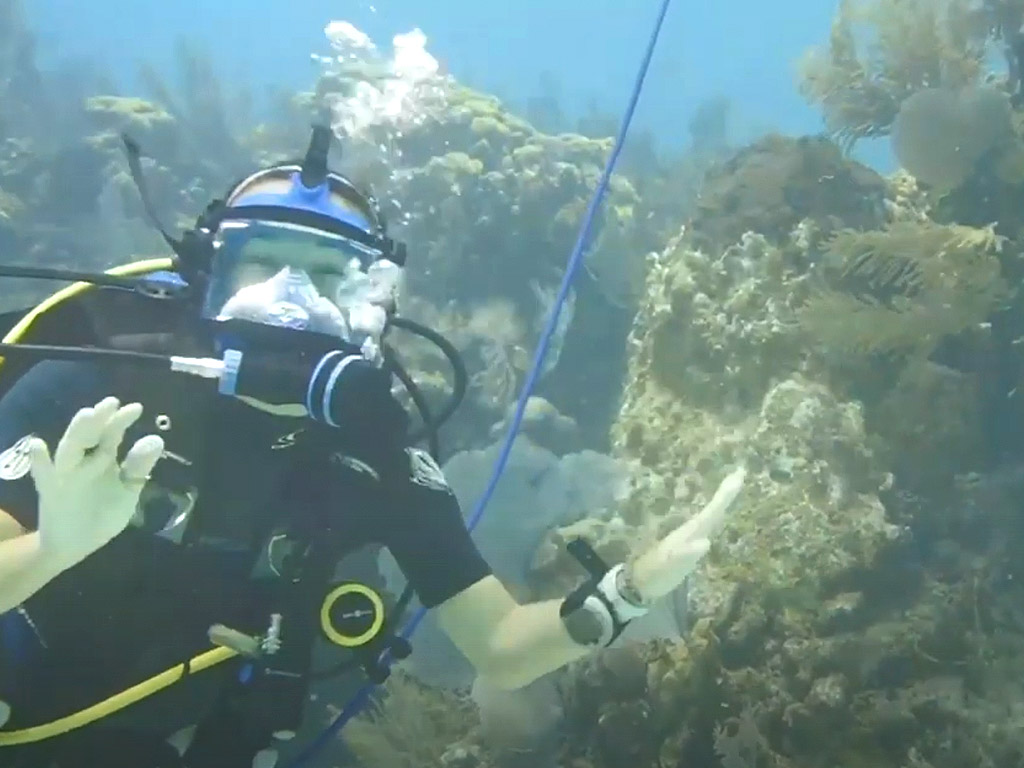
CCMI’s education team has developed a transformational, interactive education programme using Virtual Live Experiences (VLEs) methods to connect students and the public to real-time coral reef activity, in an informal science setting. Scientists use high tech face masks and streaming computer equipment to deliver live lessons from the underwater and lab environment. Innovative technology enables VLEs to reduce barriers to learning by communicating interactive ‘real-life’ experiences in an informal, scalable science setting.
The project is structured to deliver curriculum-relevant lessons which are currently oriented to the Cayman Islands and UK national science curriculum for students in year 5 and year 6 classrooms, and which can be streamed directly anywhere in the world. This groundbreaking work was piloted in local schools initially and has become an international project. In 2021, videos were viewed in 27 countries including the Cayman Islands, United States, Great Britain, Canada, Australia, Jamaica, Ukraine, New Zealand, Ecuador, Suriname, Argentina, Maldives, Norway, Mexico, Netherlands, Malaysia, Italy, Bermuda, Philippines, Slovakia, Ghana, Ireland, Bangladesh, Hungary, South Africa, and Spain!
Do you want your students to be a part of this adventure below the waves? Register for the 2025 season through the button below. Subscribe to our YouTube channel and click the “notifications” bell to receive notification and reminders about future Reefs Go Live broadcasts. While broadcasts will still be streamed live on YouTube and Facebook, to interact with our team live during the broadcasts, you MUST register BELOW to take part in any of the episodes for the season.
For free teacher resources which were created to accompany these lessons, including lesson plans, fun fact sheets, and activity sheets, visit our teacher resources page. Here you will also find shorter “mini modules” which are 3 – 5 minute lessons pulled from our Reefs Go Live content which focus on specific concepts. These also have accompanying lesson plans.
MARCH 21 – LESSON 1
Exploring the unknown ocean: Underwater mountains of Cayman
Expedition Hope mini-documentary
APRIL 11 – LESSON 2
Cryptic Creatures on the Reef
MAY 9 – LESSON 3
Endangered corals: Finding and restoring rare coral species
Mapping and retoring endangered corals mini-documentary
JUNE 6 – LESSON 4
World Ocean Day: Climate Change and Our Ocean
MARCH 22 – LESSON 1
Our Physical Ocean
APRIL 12 – LESSON 2
Researching on the Reef: The Importance of Investigation
MAY 8 – LESSON 3
Reproduction on the Reef
JUNE 7 – LESSON 4
World Ocean Day: Corals in a Changing Climate
MARCH 31 – LESSON 1
Finding Hope on Our Reefs
MAY 24 – LESSON 2
Adaptation on Coral Reefs
JUNE 2 – LESSON 3
Reef Resiliency and Restoration
JUNE 8 – LESSON 4
World Ocean Day: 25 Years of Coral Reef Research
MARCH 25 – LESSON1
Welcome to the Reef
APRIL 14 – LESSON 2
Coral Bleaching and Disease
MAY 26 – LESSON 3
Healthy Reefs Over Time
JUNE 8 – LESSON 4
World Ocean Day: Restoring Healthy Reefs for the Future
LESSON 1
Quiet Oceans
LESSON 2
Coral Reef Biodiversity
LESSON 3
Coral Reef Threats, Adaptations & Restoration
LESSON 4
Stand up for Coral Reefs
LESSON 1
Incredible Invertebrates
LESSON 2
Dive into the Life of the Sister Islands Rock Iguanas
LESSON 3
Diving Off the Wall Rebroadcast with Live Q&A
LESSON 4
How Do Scientists Grow Coral? (Special “Friday Live” Broadcast)
LESSON 5
Why Do We Need Coral Nurseries? (Special “Friday Live” Broadcast)
LESSON 1
Welcome Back to Reefs Go Live!
LESSON 2
Magnificent Mangroves
LESSON 3
Diving Off the Wall
LESSON 4
Cayman’s Reefs Over Time
LESSON 1
The Complex World of Coral Reefs
LESSON 2
Underwater Symbiosis
LESSON 3
Lionfish: The Perfect Invader
LESSON 4
How Do Scientists Grow Coral?
LESSON 5
Herbivory: Remember to Eat Your Reds, Greens and Browns!
LESSON 6
Why Are Coral Reefs So Colourful?
Reefs Go Live appreciates the past support from the following to launch this programme:
Derek Haines – and his marathon/mountain challenges
The Bank of Butterfield, Cayman Islands
The Edmund F. and Virginia B. Ball Foundation
Michael Maes – for his invaluable technical advice, time and generous equipment donations.