EDUCATION

Professional Courses

Field Research Skills in Coral Reef Management and Restoration

Course Overview

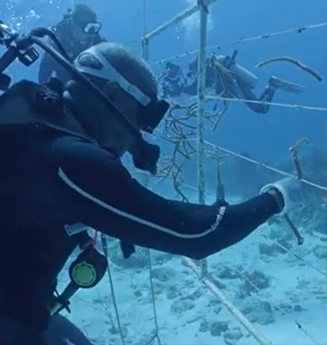
Strengthen your in-water research skills in coral reef monitoring and management while living, learning, and diving in the world-class reef environments of Little Cayman, Cayman Islands. Join CCMI for an immersive seven-day residential field course based at our remote research station, where you will gain hands-on training in coral restoration techniques leveraging CCMI’s decades-old experience in its coral nursery facility, alongside rapid reef assessment and environmental monitoring methods. You will learn from CCMI scientists who have been collecting one of the longest continuous records of coral reef health data in the Caribbean. The course also includes valuable PADI specialty certifications, taught by CCMI dive instructors, that are relevant to careers in coral reef management and marine conservation.

Who Should Join Us

This course is designed for university graduates and advanced undergraduates with a background in marine science, as well as professionals working or with an interest in tropical coastal management. 

Skills Taught in the Course

  • Coral Reef Restoration: restoration techniques, nursery tree installation, reef fragmentation, and outplanting
  • Rapid Reef Assessment: Using transects, quadrats, and AGRRA methodology to assess coral reef species abundance, distribution, diversity, and biomass
  • Environmental Assessment: Identification and survey methods of indicator species; mapping ecological indicators; identification and monitoring of keystone species, coral bleaching, and diseases. Measuring reef rugosity and coral recruitment.

Dive Certifications Earned

  • PADI Peak Performance Buoyancy (PPB) Specialty certification: learn to master precise, effortless buoyancy control, and improve air conservation, to work effectively underwater and avoid disturbing marine biota
  • PADI AWARE Specialty Certification: Coral Reef Conservation

Participant pre-requisites

Experienced Open Water divers (a minimum of 12 dives; a minimum of 2 dives in the last 12 months). Additional dive experience or certifications welcome but not required. A basic knowledge of marine ecology is expected.

Coral Reef Resilience and Restoration Course

Course Overview

This immersive field-based course introduces students to the science and practice of coral reef resilience and restoration, combining ecological theory with hands-on training in one of the Caribbean’s most remote, least developed, and best protected reef systems. 

Based at CCMI’s research station on Little Cayman, a Mission Blue Hope Spot, students will explore how coral reef ecosystems function, how they respond to disturbance, and how targeted management and restoration interventions can enhance reef recovery. This intensive eight-day course combines classroom learning, ample in-water training, independent research, and hands-on restoration work. 

CCMI’s remote research station provides exceptional access to some of the Caribbean’s healthiest coral reefs and a regionally recognized coral restoration programme. Students are taught by marine scientists and conservation practitioners with decades of experience. They will gain insight into conducting research in resilience-based management while actively contributing to coral reef conservation. 

Who Should Join Us

  • Undergraduate students in marine science, biology, environmental science, or related fields 
  • Early-career ocean professionals seeking hands-on experience in marine research and coral reef restoration 
  • Students comfortable in the water (snorkellers required; SCUBA divers of any level are welcome)

Learning Objectives

By completing this course, students will be able to: 

  • Explain the ecological processes that underpin coral reef resilience 
  • Identify major Caribbean coral species, reef habitats, and key functional groups 
  • Design and implement a small-scale field research project (snorkel- or SCUBA-based) 
  • Assess reef health using standard ecological monitoring techniques 
  • Evaluate global and local stressors and their synergies, including bleaching impacts, disease, and the effects of fishing pressures 
  • Apply core coral restoration techniques, including coral nursery construction, coral fragmentation and propagation, and nursery maintenance 
  • Communicate scientific findings effectively through presentations and field reports 

Skills Taught in the Course

  • Independent field research design and implementation 
  • Reef monitoring and ecological survey techniques 
  • Coral nursery construction and maintenance 
  • Coral restoration strategies, techniques, and limitations 
  • Scientific communication and teamwork in a remote field setting 

Dive Certification Earned

  • PADI AWARE Specialty Certification: Coral Reef Conservation

Participant pre-requisites

  • Confident swimmers
  • Snorkelling experience
  • Optional SCUBA diving certification (any level is welcome)
  • A background in science  

If you are unsure if you meet the pre-requisites, please contact us, and we’ll be happy to discuss if this course if appropriate for you 

Corporate Marine Sustainability Retreats

Course Overview

Get out of the board room – and dive into nature for your next retreat! This immersive 4-day residential programme equips corporations and institutions (their leaders and employees) with evidence-based understanding of why marine sustainability and coral reef resilience matters to business continuity and ESG performance. Participants will explore coral reef ecology, resilience science, climate impacts, and marine governance while gaining practical frameworks for corporate action that meets your company’s stated goals.

COURSE MODULES

This immersive experience goes beyond traditional team building. Participants learn to design actionable 12–24 month Corporate Marine Action Plans that strengthens ESG performance while benefiting local marine ecosystems and communities. This roadmap includes capacity building and knowledge transfer for new employees as well as pathways for creating partnerships with local communities on coral reef restoration, MPAs surveillance, blue-carbon initiatives, and other marine conservation outcomes.

CCMI will work with your company to create a tailored syllabus to meet your goals for your retreat. You will receive the three core modules below PLUS one optional module to complete your course. Additional modules can be added for an additional cost, and they would require extra days added to the course.

Course modules include:

  • Foundations of Coastal Economies: Coral Reef Ecology and Resilience
  • Plastic Pollution and Ocean Health
  • Exploring Little Cayman Coral Reef Biodiversity by Boat
  • Sustainable Seafood and Supply Chains (optional)
  • Marine Protected Areas (MPAs) and Conservation Finance (optional)
  • Ocean Health and Corporate Risk Reduction (optional)
  • Hidden Reef Dynamics: Nocturnal Ecosystem Function and Biodiversity (optional)
  • Coral Reefs in a Changing Climate: Risk, Resilience, and Corporate Responsibility (optional)

Set against the extraordinary backdrop of Little Cayman, a Mission Blue Hope Spot, this retreat builds stronger teams while positioning your company as a true environmental leader in the Cayman Islands.

COURSE OUTCOMES

Participants learn to design actionable 12–24 month Corporate Marine Action Plans that strengthens ESG performance while benefiting local marine ecosystems and communities. Such roadmap includes capacity building and knowledge transfer for new employees, as well as pathways for creating partnerships with local communities on coral reef restoration, MPAs surveillance, blue-carbon initiatives, and other marine conservation outcomes.

The course will be presented using a variety of instructional methods, including: lectures, direct field observations (e.g., snorkelling in healthy vs. degraded coral reefs around Little Cayman; observing a coral nursery and its upkeep), group field activities (e.g., building reef restoration field tools; beach cleanups), field notebooks (participants are asked to keep a field notebook to record field observations and reflections), literature reviews and class discussions, and small group presentations.

Participants will liaise with local businesses, government agencies with direct responsibility for marine ecosystem monitoring, and conservation NGOs on Little Cayman.

There will also be time during your visit to CCMI to explore the beauty of Little Cayman through the use of our bicycles and kayaks. Life at the field station is a truly unique experience, complete with nightly stargazing, beach BBQs, and an ocean view of the Bloody Bay Marine Park just steps from your bedroom door!

Fee includes full room and board (3 meals/day, 4 days/3 nights in shared dorm-style accommodation with bunk beds), CCMI team instruction and support, ground transportation in Little Cayman, dives/snorkels for each module, and snorkel gear. SCUBA participants are advised to bring their own dive gear, if possible, for enhanced comfort.

Fee does not include flights or DAN insurance for divers. 

“It was an exciting and informative trip that I suggest every young person take. The least polluted reefs I have seen and the huge creatures that I usually don’t get to see. The staff was very informative and understanding and was very happy to talk about their jobs.
Danica Birriel
CMEC 2023
It was fun and inspiring; it made me excited for my future as a marine biologist and the staff were super helpful and willing to answer questions, as well as being fun and cool.
Kaitlyn Cumings
CMEC 2023
There was never a dull day here, we had many thrilling adventures. During the CMEC camp you meet and connect with so many incredible people. You are always surrounded and supported by the amazing staff that make sure your camp is the most spectacular experience you can have. Definitely a priceless and unforgettable experience for me.
Janelle Smith
CMEC 2021, 2024
My oldest son attended this camp four years in a row. Now that he is in college, my youngest son wanted to join to see what it was all about. He was NOT disappointed! He came home with the new career goal of wanting to become a marine biologist and already wants to return in 2023!
Christina
Mother of 2 CMEC alumni