CONTACT
 gallery
 facebook
 instagram
 youtube
 twitter
Supporter update – July 2026
Building Momentum for Our Ocean
Bringing the ocean to the big screen through immersive learning and creative engagement
World Ocean Day was marked by one of our most engaging education programmes to date, bringing together students, teachers, and members of the wider community through a series of experiences designed to deepen understanding of the ocean and inspire long-term stewardship.
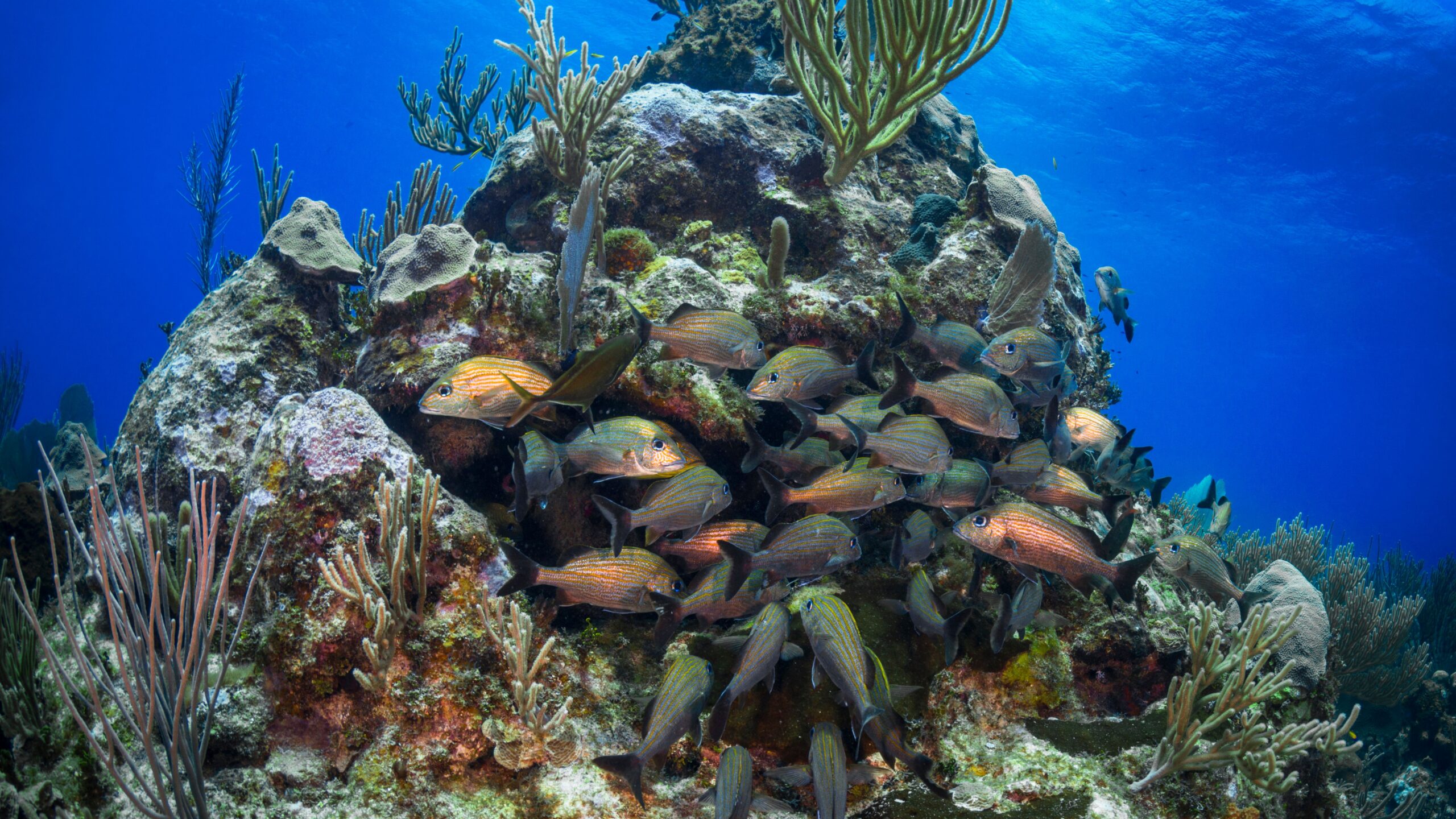
At the Camana Bay Cinema, we delivered Reefs Go Live, welcoming 510 students and teachers from nine schools, alongside members of the public, to experience a live underwater broadcast from Little Cayman. Seeing students connect in real time with our reef systems and ask questions directly to our team in the field was a powerful reminder of the role that immersive learning plays in building ocean literacy. We are extremely grateful to the Edmund F. and Virginia B. Ball Foundation for supporting Reefs Go Live and for Dart’s ongoing investment in the World Ocean Day event that brings the ocean to classrooms in Cayman and abroad.
COMMUNITY OCEAN ACTION
Announcing the Doug Allan Ocean Sustainability Awards to recognise business leadership in the Cayman Islands to act for our one shared ocean
This World Ocean Month also saw the launch of a new awards initiative designed to deepen engagement with the private sector in Cayman. The Doug Allan Ocean Sustainability Awards, named in honour of the late Doug Allan OBE, seek to recognise businesses that are demonstrating leadership in environmental stewardship and marine sustainability.
The awards form part of a broader effort to strengthen CCMI’s engagement with the corporate community, not only by recognising leadership where it already exists, but also by encouraging more organisations to take meaningful steps toward integrating sustainability into their operations.
As we continue to expand our work with businesses through sustainability courses and advisory engagement, we see this as an important moment to build stronger bridges between science and the private sector, and to support companies in becoming active partners in ocean conservation.
SCIENCE NOTES FROM THE FIELD
- Advancing coral restoration science and understanding reef resilience in a rapidly changing ocean
On the science side, our work continues to focus on understanding how Little Cayman’s reefs are responding in the aftermath of the 2023 bleaching event and ongoing thermal stress across the region. While the changes we are observing are significant, what remains clear is the importance of long-term monitoring in understanding both resilience and vulnerability within these systems.
In March, our coral nursery expanded to nearly 300 staghorn coral (Acropora cervicornis) fragments across three genotypes, and the team continues detailed monitoring of growth, health, and survival rates to inform future restoration strategies. Alongside this, we are beginning to explore the potential of deeper reef environments as thermal refuges, piloting the nursery at depths of up to 30 metres. This will help us better understand whether certain genotypes demonstrate improved performance under different environmental conditions and how restoration approaches may need to evolve in response to a changing ocean.
We are also preparing for a pilot elkhorn coral (Acropora palmata) nursery project, which will allow us to compare nursery-grown corals with their parent colonies. This work is particularly important in the context of preserving genetic diversity, as we look at how best to safeguard these iconic reef-building species for the future. Wild colonies of elkhorn coral have been observed in the bay by our field station, so this is the ultimate time to launch this new species in the nursery.
Watch our recent Reef Lecture: The Story of The First Coral Nursery in The Cayman Islands for project updates delivered by Nicole Rotelle, CCMI Research Assistant.
- Expanding our understanding of coastal blue carbon systems and their role in climate resilience
Our Blue Carbon Offset and Biodiversity Project, supported by Butterfield and Wheaton Precious Metals International, continues to deliver important insights into the role of coastal ecosystems in carbon storage and biodiversity support. Now in its third year, the project is helping us to better understand seagrass productivity, habitat structure, and the wider ecological value of these environments.
Some exciting results have already emerged from the project, including the finding that co-locating coral reefs next to seagrass meadows significantly increases sediment accumulation and thus carbon sequestration. The project has also developed the first formula to quantify carbon storage in restored corals and measured carbon storage in Little Cayman’s seagrass meadows, which is higher than the regional Caribbean average. These results are some of the first of their kind and present a significant development in understanding carbon storage capacity in the Cayman Islands.
This season’s fieldwork has focused on validating satellite imagery and refining habitat mapping, alongside detailed measurements of seagrass productivity during peak growth periods. These data sets are essential in building a clearer picture of how these ecosystems function under changing environmental conditions, and how they contribute to both climate mitigation and coastal resilience. The current phase of fieldwork will conclude in July, after which we will begin preparing the final analysis and reporting.
EDUCATION WITH INCREDIBLE IMPACT
Preparing for CCMI’s largest Marine Ecology Course as we welcome more than 400 Cayman Primary School scholarship students to Little Cayman
Preparations are now well underway for our largest Nancy Binz Marine Ecology Course Scholarships to date. Between September and December, we will welcome approximately 420 Year 6 students and their chaperones from across Cayman Islands Government Schools to Little Cayman. CCMI launched and funded this programme at our gala in 2025, where we raised an incredible USD $300K to support an entire year group from public schools, making a tangible dent in our goal to ensure all students are literate by the age of 12 in the Cayman Islands.
For many of these students, this 3-day, 2-night residential course will be their first experience of Little Cayman and its surrounding marine environment. The opportunity to learn directly within the ecosystem they are studying is something that stays with them long after they return home, and we consistently see how this experience shapes their understanding of the ocean and their role in protecting it.
This programme represents a significant logistical and educational undertaking for the team, and I am incredibly grateful to our partners at the Ministry of Education, Cayman Airways, and our wider group of partners for making it possible. I would also like to thank Dart (who provided $200 K in support), as well as CUC and KPMG for making this milestone programme possible through essential sponsorship. We also appreciate the support of Divers Supply and Walkers who have helped us purchase necessary snorkel and education materials to ensure all students have a safe and supported learning experience at their MEC.
LAUNCHING OUR OCEAN DECADE CAMPAIGN
Building long-term resilience for CCMI through the remaining years of the United Nations’ Ocean Decade (2021-2030)
As we look ahead to the remainder of 2026, we are also preparing to formally launch our Ocean Decade Campaign, which will be a key focus of our VIP engagement over the coming months. The U.N. Ocean Decade looks to combine increased public engagement and stewardship of the ocean, alongside looking for tangible solutions to create meaningful impact and change. We are leveraging this international focus to highlight how we are shifting as an organisation to create more impact, in the face of coral reef decline and ecosystem degradation. This initiative is designed to secure an additional $1.5 million in multi-year unrestricted funding to support CCMI’s long-term resilience and impact through 2030.
These funds will allow us to strengthen our core science and monitoring programmes, expand our education and scholarship work, invest in critical infrastructure, and respond more effectively to emerging conservation needs. Importantly, it will also give us the flexibility to pursue new opportunities as they arise, ensuring CCMI remains responsive and relevant in a rapidly changing ocean environment. The marine environment requires action now— yet geopolitical issues mean funding is limited in key areas, such as research. This campaign seeks to underpin our ability to be agile, provide seed money and project expansion support, in the face of declining government (U.S. and U.K.) science budgets.
We are grateful, as always, for your continued support of CCMI. Everything we do— from inspiring young people through education, advancing coral restoration science, to engaging communities and businesses in ocean action— is made possible through your commitment and belief in this work.
Thank you for being part of this journey with us as we continue to work toward a more resilient future for our ocean.
With gratitude,
Kate Holden, CEO
We are well into World Ocean Month, and I wanted to take the opportunity to share an update on what has been an incredibly active and inspiring period across CCMI. From World Ocean Day engagement with schools and communities, to new developments in our science and education programmes, and launching our long-term Ocean Decade funding campaign, a real sense of momentum is building across the organisation. None of this would be possible without your continued support, and I am deeply grateful for your ongoing commitment to our work.