CONTACT
 gallery
 facebook
 instagram
 youtube
 twitter
Islands of Change: Connecting Caribbean educators with the ocean
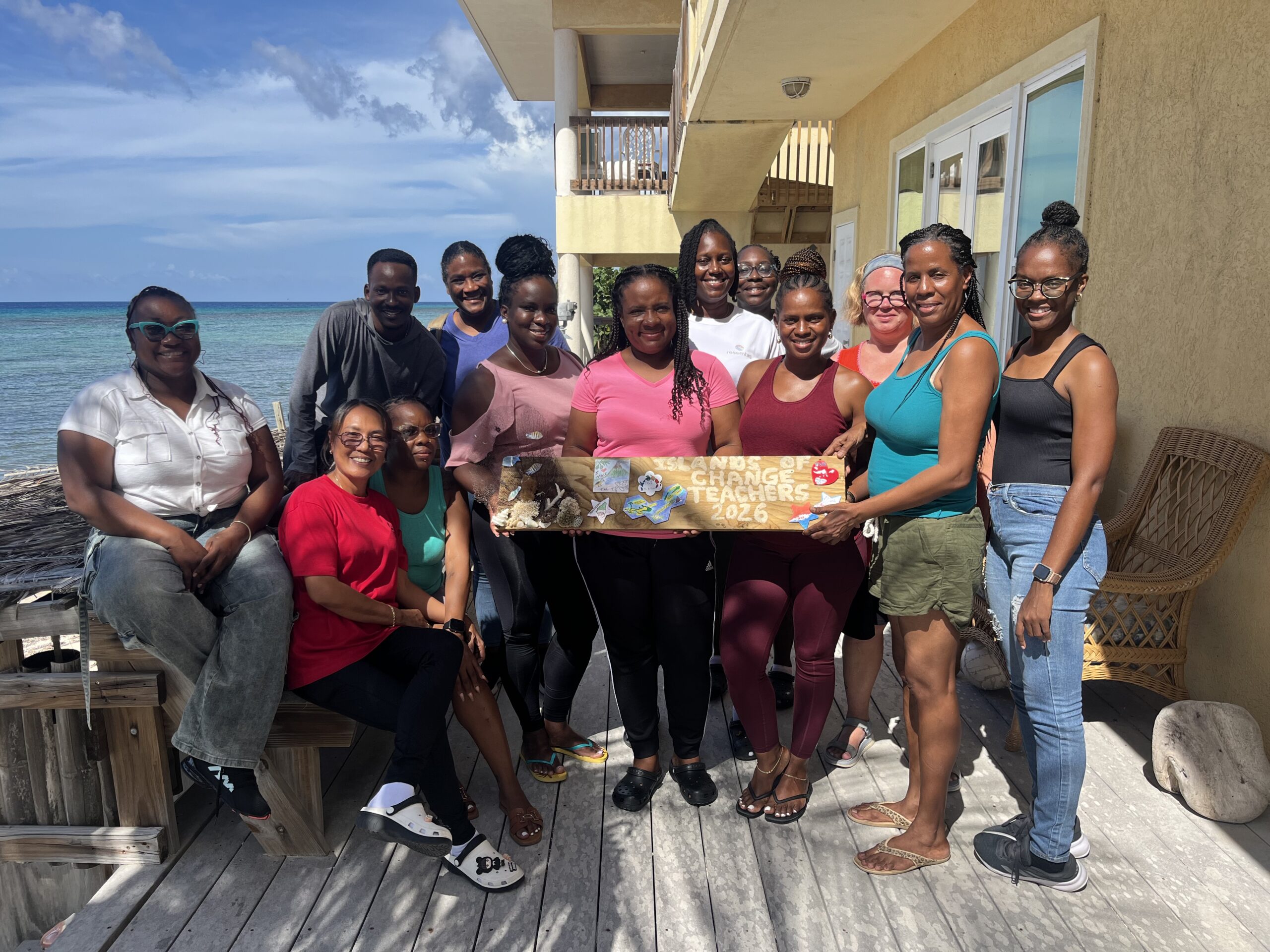
For some of the educators gathered on Little Cayman, this workshop offered a first opportunity to explore a coral reef through a snorkel mask. For others, it brought familiar classroom topics to life in new ways. For all 13 participants, “Islands of Change: Empowering Environmental Educators Across the Caribbean” was an opportunity to deepen their marine science knowledge and connect with colleagues working across the region.
Held at the Central Caribbean Marine Institute’s (CCMI) Little Cayman Research Centre from 3–7 August 2026, this five-day workshop brought together educators from the Cayman Islands, Anguilla, the British Virgin Islands, Montserrat, and the Turks and Caicos Islands. With funding from The UK Government’s Darwin Plus Local Programme, The Fishmongers Company Fisheries Charitable Trust, and The UK Government’s Blue Belt Programme, the project combined scientific learning, practical field experiences, and collaborative planning to help educators bring marine conservation and climate resilience into their teaching.
The purpose
Small island states contribute only a tiny fraction of global greenhouse gas emissions, yet they are among the most vulnerable to the impacts of climate change. Across the Caribbean, climate-driven stressors are intensifying, including increased storm frequency and severity, rising sea levels, coastal erosion, coral bleaching, and accelerating biodiversity loss. These changes threaten not only natural ecosystems but also the social, cultural, and economic foundations of island communities.
CCMI has more than 15 years of experience delivering immersive, experiential education programmes in marine and coastal ecology to children and adult students. Over the years, teachers accompanying student groups have, with increasing frequency, expressed a desire to participate more fully themselves and repeatedly requested professional development opportunities tailored specifically to educators.
This project, Islands of Change: Empowering Environmental Educators Across the Caribbean, responded directly to this demonstrated need. The project adapted CCMI’s proven education model into a “Train the Trainer” framework designed to build capacity among environmental educators from five Caribbean UK Overseas Territories: the Cayman Islands, Anguilla, the British Virgin Islands, Montserrat, and the Turks & Caicos Islands. By focusing on educators rather than students alone, the project intentionally multiplies its impact, enabling trained teachers to reach hundreds of learners within their own schools and communities over time.
From classroom concepts to living reefs
Caribbean educators have an important role in helping young people understand the coastal environments on which their communities depend. Yet opportunities to explore those environments first-hand can be limited. Before the workshop, 70% of survey respondents reported that their schools did not currently offer students many opportunities for outdoor, experiential marine learning.
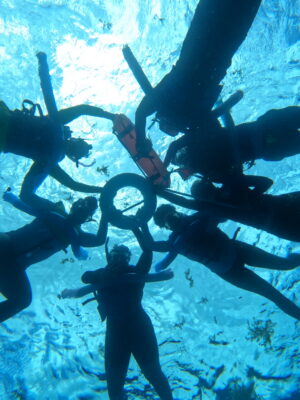
CCMI designed the programme around participants’ needs, combining teaching resources and curriculum connections with opportunities to develop practical skills. Sessions explored coral reefs, mangroves, and seagrass beds, alongside coral bleaching, climate adaptation, and mitigation, and nature-based solutions such as coral restoration.
The surrounding environment became an extension of the classroom. Reef snorkels and boat-based field days gave educators opportunities to identify fish, corals, sea turtles, and other reef organisms and observe marine ecosystems directly. A nature walk explored mangrove diversity and the connections between coastal habitats while a CCMI-produced virtual reality diving experience offered another way to discover Little Cayman’s underwater world from below the surface, as if the participants were SCUBA diving certified.
Participant feedback highlighted the value of this connection between scientific instruction and direct observation. As one educator explained:
“This combination of classroom instruction and experiential learning made the concepts much more meaningful and reinforced my understanding of coral reef ecosystems.”
Others identified immediate links to their teaching, including using fish morphology to explain classification and incorporating coral and fish identification into Grade 7 science.
Building confidence through experience
One of the workshop’s most meaningful achievements was that every educator participated in boat snorkels and experienced Caribbean coral reefs first-hand. This included participants who arrived with no water experience and apprehension about entering the ocean.
CCMI’s education team supported the educators as they tried unfamiliar activities, answered questions, and connected field observations with the science discussed in class. Participants praised staff members’ knowledge, encouragement, and willingness to explain concepts.
For one first-time snorkeller, the experience opened up a new perspective:
“The snorkeling was awesome! It was my very first time doing it and I realized I was truly missing out!”
These experiences gave educators a personal reference point for considering how outdoor learning could enrich their own students’ understanding of the marine environment.
The post-workshop survey that the CCMI team designed and asked all participants to complete also showed a strong response to the programme’s educational aims. All 12 respondents reported that the workshop helped them “a lot” to understand and explain the role of coral reefs, mangroves, and seagrass ecosystems in Caribbean island resilience to their students.
A regional exchange with classroom potential
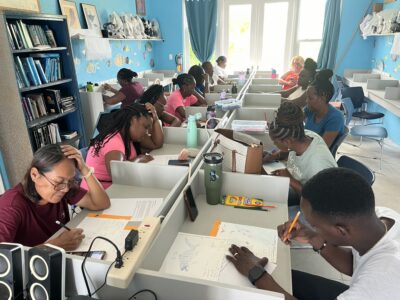
The workshop created space for educators to learn from one another as well as from CCMI. Participants mapped and shared personal stories of environmental and social change, exploring how different island communities experience and respond to change.
These exchanges connected scientific concepts with local experience and helped build relationships across five Caribbean UK Overseas Territories. Educators also worked together, with guidance from CCMI staff, to develop resources for their students.
The programme followed a train-the-trainer approach: supporting educators who can, in turn, share knowledge and practical learning opportunities with successive groups of young people. Many participants captured that ambition in their feedback, such as this one:
“I am now more confident in bringing this knowledge and experience back to my classroom and sharing it with my students.”
Extending the learning beyond Little Cayman
Following the workshop, CCMI assembled individualised Environmental Education Toolkits, developed with participants at the workshop to reflect their teaching needs. Depending on those needs, the toolkits include snorkelling equipment and life vests, identification slates, water-quality testing kits, microscopes, dissection equipment, tidepool nets, and digital teaching resources.
By combining professional development with practical resources and a network of regional connections, Islands of Change has laid a foundation for multiplying regional learning beyond the workshop itself. CCMI is helping Caribbean educators turn first-hand experiences of the ocean into opportunities for young people of five UKOTs to understand, value and care for their islands’ marine environments.
BACK